The Sensory WorldChapter III · Saturday 21 November 2026
Perfumer, thy name is nobody
Born in St Petersburg in 1914, Yuri Gutsatz is said to have scented the Paris Opéra, built perfumes for India and spent decades arguing that noses deserved their own names. At 61 he planted a garden of his own.
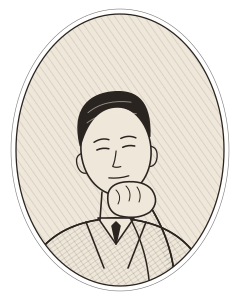
Yuri Gutsatz spent most of his working life making scents that carried other people’s names. He was born in St Petersburg on 6 July 1914, into the last years of the old empire, and by the time he died in Paris in April 2005, at 90, he had lived in Russia, Germany, France and India, set up an ingredients factory in Bombay and, by his biography’s account, scented a production at the Paris Opéra. He left behind some two thousand formulas. Very few of them bear his name. That was the point he spent his later years making.
Two exiles
The revolution took the family west in stages. In 1924 the boy left for Berlin with his mother and his father’s parents; his father, David, a chemical engineer, stayed behind in St Petersburg. In 1933, with the Nazis in power, Berlin was no longer safe either, and Yuri moved on to Paris, about nineteen years old and without a trade. The family story holds that in 1934 father and son, more than a thousand miles apart and out of touch, were both working on perfumery without knowing it of each other.
An absolutely extraordinary phenomenon which in my 35 years of practice I have never encountered.
In Paris he found work at Parfums de Mury, the house that owned Paul Poiret’s perfumes, and was asked to bring forty of the old Poiret scents up to date. The war ended that. He also met two of the great figures of French perfumery, Jean Carles and Louis Amic, and the formulas his family keeps today go back to 1935. When war came he joined the Foreign Legion and served in Algeria. By the early 1940s he was in Marseille, in the unoccupied zone, working for the Société Française de Parfumerie, and carrying a safe-conduct pass that let him travel to Grasse to call on its perfume houses. The pass survives.
Roure, and the Opéra
After the war he went to Roure Bertrand Fils et Justin Dupont, the Grasse house, as a chief perfumer under Louis Amic, a post his son Michel says he held for some thirty years. The work was anonymous by design. A perfumer at a supplier house wrote formulas; the couturier on the label took the credit. In 1950 one of his formulas became Chasse Gardée for Carven. In 1952, by the account in his biography, the Opéra’s director, Maurice Lehmann, asked him to scent the house during Les Fleurs, the third entrée of Rameau’s Les Indes galantes, in its new production.
Then Roure sent him east. From the mid-1950s he spent about six years in Bombay, where he set up an ingredients factory; by the account in his biography it was Industrial Perfumes, run with the Tata group, and he created the perfumes for Lakmé, Tata’s cosmetics brand. He came back with an interest in Indian materials. In 1969, working on a first perfume for Emanuel Ungaro with Estée Lauder, he built keora, the screw-pine flower prized in north Indian attars, into the accord for its odd green, metallic note.
His 1969 report to Amic on that project holds the best surviving example of his own voice. Lauder, he wrote, had skin that ate perfume: “an absolutely extraordinary phenomenon which in my 35 years of practice I have never encountered. A perfume lavishly spread on the back of her hand or forearms loses its smell within less than 5 minutes, leaving after 10 minutes a faint and blurred odor!” The Ungaro project was abandoned; by the account of the perfume writer Denyse Beaulieu, who quoted the report on her blog Grain de Musc in 2009, its work later became Lauder’s Chromatics in 1973. He also worked on projects for Mary Quant, Cartier, Dior and Van Cleef & Arpels.
A name of his own
On 12 December 1975, aged 61, he registered a trademark of his own: Le Jardin Retrouvé, the garden found again. His wife, Arlette, drew the logo and ran the sales. It was a small house with an idea larger than itself. The scents came in refillable bottles and were sold on the strength of their materials, not on a fashion name; his family remembers his rule that when an ingredient is truly good, you do not need much of it.
He became an advocate for his trade as well as a practitioner. In 1976 he took over the bulletin of the society now called the Société Française des Parfumeurs, and from 1978 to 1986 he was its vice-president. On 17 May 1979 he gave the talk that summed up his argument, « Parfumeur, ton nom est personne » — perfumer, your name is nobody. As his son later summed it up, the argument was that the noses who built the great French scents were treated as anonymous technicians while the houses selling their work took the glory. His daughter-in-law, Clara Feder, credits him with theorising a parallel perfumery, in which perfumers were free of marketing constraints and chose their own materials. Half a century later that is simply how niche perfume works.
In 1990 he was one of the founding perfumers of the Osmothèque in Versailles, alongside Jean Kerléo: an archive where lost and discontinued perfumes are rebuilt from their formulas and kept, so that they can still be smelled. It was the same instinct as his own garden, applied to a whole profession’s memory.
The garden, reopened
He died in 2005. Arlette died in 2012. Le Jardin Retrouvé went quiet, but the formulas did not disappear. In 2016 his son Michel Gutsatz and Michel’s wife, Clara Feder, relaunched the house in Paris from Yuri’s archive. Michel has said that letting customers choose which of Yuri’s formulas to revive was the best tribute they could pay to the work of his father, whom he describes as a perfume creator, a humanist and a cosmopolitan.
The revived house sells mainly his compositions, adjusted by the perfumer Maxence Moutte, who has also added four scents of his own since 2021. Tubéreuse Trianon was its bestseller in 2022, Michel said; he remembers his father saying it was meant for American women, because tuberose and America had a love affair. Cuir de Russie, the most personal, was made in 1977 to recapture a childhood memory of his father’s leather uniform. Clara describes Yuri as a nomad who had finally settled in a garden protected by walls.
It is a fitting end for a man who argued that a perfumer’s name should be on the bottle. For most of his career it was not. Now the house credits him by name on the scents it sells.